Wednesday, October 18, 2017

Sending Kind Thoughts to our Everyday Superheroes


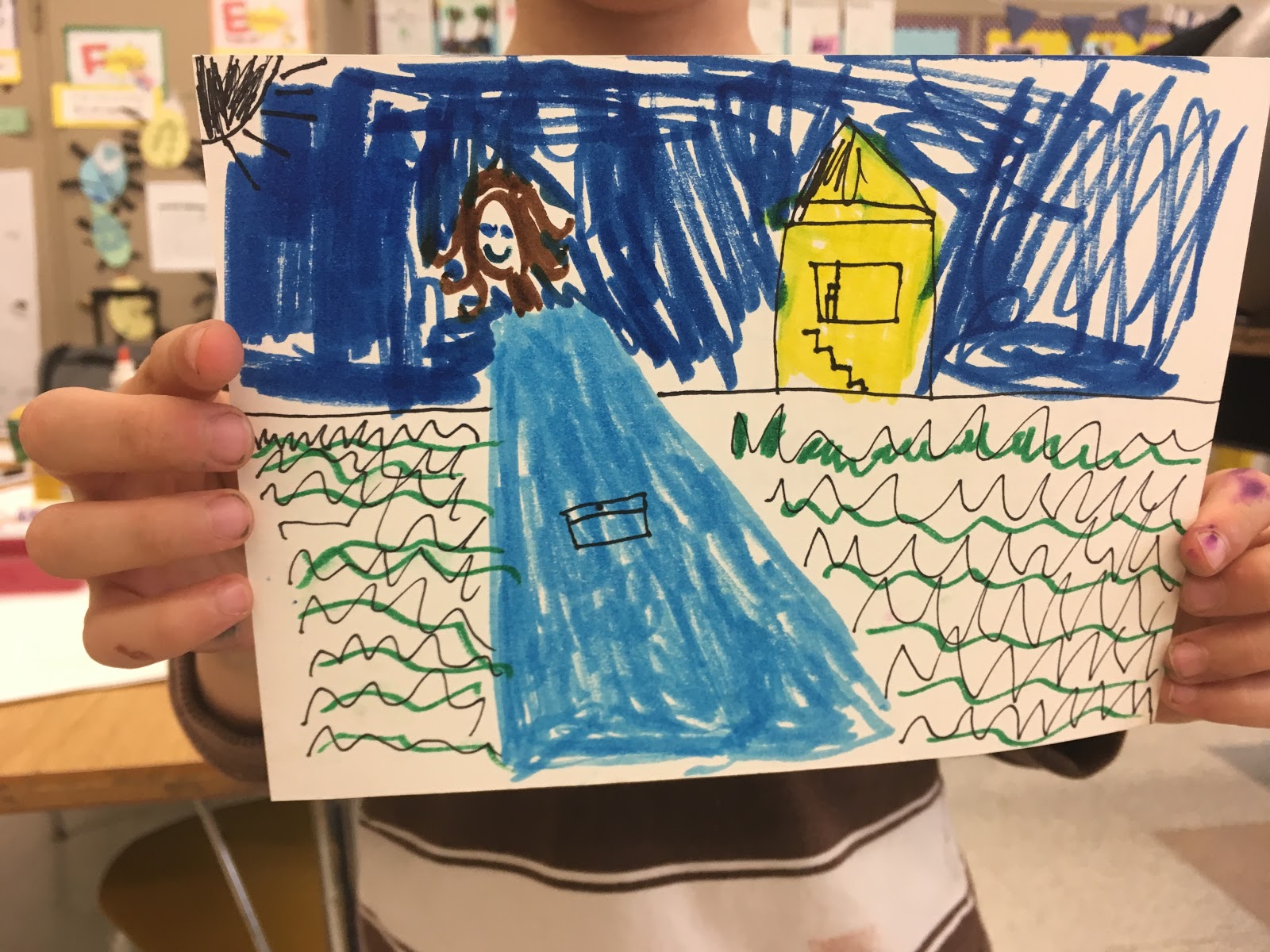
This Kindergarten artist chose his Grandma as his Everyday
Superhero!  He talked about how she saves "treasure"
for him at her house, and how she is making him a
Halloween costume this year.
Each Mind Move Make class is packed with loads of different activities, and all of them blend into one another!  In the Mindfulness part of the class we've been slowing down and focusing on the present moment in many different ways.  During each class I select a Mindful Leader to conduct our Mindful Breathing practice.  For most of the classes we've used a Breathing Ball, or Hoberman Sphere.  After I demonstrated using the Breathing Ball during the first class, the students have been leading one another in mindful breathing by expanding and contracting the ball.  The students have also found their pulses or put hands on their hearts and counted heartbeats to find calm and focus.  It is amazingly beautiful how silent the room becomes when everyone is counting their heartbeats.


During another class the students sent kind thoughts to the person they chose as their Everyday Superhero.  Each student found a very comfortable position, either sitting or laying down, and I said these Heartful phrases while they repeated them in their minds and thought about the special individual they selected:

May you be safe and protected.
May you be healthy.
May you be loved.
May you be happy.
May you live in peace.

I allowed the students time and space to think about their own, personal kind wishes that they wanted to send to their Everyday Superhero.

In the art realm of the class, students experimented with using markers, then brushing water on top of the marker with a paintbrush.  The paper I gave the students to create their Everyday Superhero postcards is high-quality watercolor paper.  When water is brushed onto the marker, the pigment of the marker looks and acts like watercolor paint.  The students were surprised and excited by the results of this experimentation.  During our next class, many students told me that they tried this fun technique at home with their own markers.

A stamp was created for the back of their postcard, just like a real postage stamp.   The children wrote a message to their Everyday Superhero explaining why they are grateful to them.  The students range in age between 5 years and 10 years, so there is a large variation in skill and ability when it comes to writing.  I supplied the younger students with a prompt sheet to use and glue on the back of their postcard to write their message.  Some of the TIS students wrote their note in their target language as each child is learning either Spanish, Mandarin Chinese, or Japanese.  Many of the children used their own words to express their gratitude and appreciation for their Everyday Superhero.  

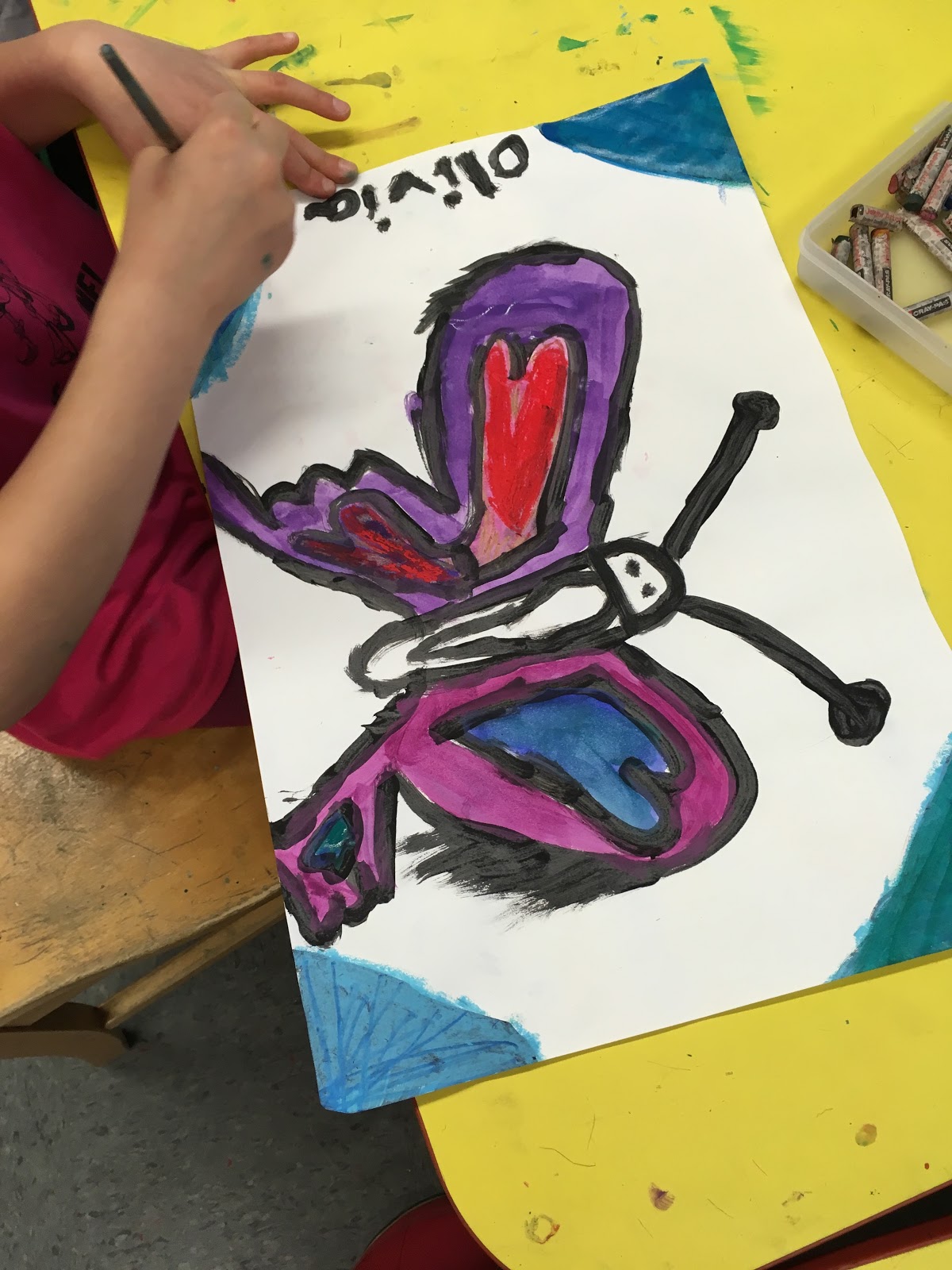
Here are the fronts and backs of many of the postcards.  I had the postcards lined up on the floor so that the parents could see all of the unique, fantastic drawings.  One parent commented, "I would buy many of these postcards and send them myself!"  So would I; they are beautiful.

From TIS:


From Alameda:


Tuesday, October 3, 2017

Everyday Superhero Postcards

"What is a community?"....this is a question we'll be discussing throughout Session One of Mind Move Make.  At Alameda Elementary and TIS, the students have had very specific, comprehensive ideas of what a community is and the function of a community.  We've been talking about how we are creating a tiny community in our Mind Move Make class, and we are all part of a larger community also.

During our second Mind Move Make class, the students created Community Maps.  These maps are a collection of three circles, a central circle with the core people that the student is closest to, a middle ring for people who are very important (friends, teachers, cousins), and a third circle for people who help us but we might not know very well (custodians, school secretaries, letter carriers, garbage collectors).  My goal is for each student to realize that there are SO MANY PEOPLE who help and support us everyday!  Here are a few of the Community Maps created by students.


During our next class I asked these three questions of the students:

1. What is an Everyday Superhero to you?
2. Looking at your Community Map, who will you choose as your Everyday Superhero? 
3. How are you grateful to this person?

I explained that we would create Everyday Superhero postcards for one individual from our Community Map to tell them how much we appreciate the work they do for the community.  I have an extensive postcard collection, and I brought in several to share with the students.  I also designed a postcard for my own Everyday Superhero, a security guard who I see feeding the pigeons around TIS.  He has a parade of pigeons following him every time I see him, and this just makes me smile.  It is a small thing, in a way, but it makes me so happy to see him surrounded by pigeons.  He is usually smiling and talking to them in a low, cooing voice.  For my Everyday Superhero postcard design, I depicted Super Pigeon!  I'll post a picture of Super Pigeon when it is finished.

All the students created a sketch in their sketchbooks of what they wanted their Everyday Superhero postcard to look like.  Then they transferred the design onto a very nice piece of watercolor paper cut into postcard size.  I truly enjoyed visiting each student and asking about the individual they chose for their Everyday Superhero.  Many students chose either a current or a former teacher.  One student chose his origami teacher and crowned him Origami King!  Another boy picked  his Mother and turned her into Waffle Woman because she makes him waffles for breakfast many mornings during the week.  Here are many of the quirky, fun, beautiful artworks the students created!


Friday, September 15, 2017

Everyday Superheroes: Session 1 for the 2017-2018 School Year

The first classes for Session 1 of Mind Move Make have started!  For this collection of classes we are focusing on the idea of Everyday Superheroes.  I'll be asking the students to look at their community and reflect on the people who help and support them everyday.  The students will also identify their own inner superpower and think about how they can use this power in a positive way to help people around them.

During our VERY first class we started by getting the wiggles out and also practicing Tadasana, or Mountain Pose.  Each child stood in their most solid Mountain Pose and I went around the circle trying to push him or her over.  It is surprising how strong children can get standing in this grounding pose!  Then we shook, danced, and moved all around, but when I said "Mountain!" all the students needed to once again find their strongest standing pose.

After that, everyone grabbed their snack and we discussed the three parts of the class: MIND, MOVE, and MAKE.  Many students shared what their ideas of mindfulness, movement, and artistic creation were.  Then we talked about COMMUNITY, what a community is, and how we are working to create a community together in this class.

Since this was our first class we took the time to introduce ourselves!  Standing in a circle I asked everyone to share his or her name and the superpower he or she most wanted to have while reflecting on how this superpower could help others.  Then each person created an individual movement that everyone in the class had to perform while saying his or her name.  It was fun hearing everyone's desired superpower and watching each student lead the group in a quick movement activity.  The students came up with amazing superpowers!  One girl wanted to be able to talk to animals, another teleported using rainbows, and yet another had the ability to grant any wish imaginable but also to take the wish away if it was used in a negatively.  Wow!

After that, we focused on the mindfulness part of our class.  I talked about how mindfulness is paying attention to what is happening right now, in the present moment.  Everyone was sitting on the floor in a circle, and I asked each child to slump over and try to take a good, deep, nourishing breath.  "Was that hard or easy?  How did that feel in your body?" I asked.  Everyone agreed that it was hard to take a deep breath when the body was in a slumped form.  Then I had everyone sit up straight and tall and try to take a breath.  Everyone thought that that was much easier and felt so much better!  "This is your mindful body," I said, "throughout the course of this class I'll ask you to find your mindful body."  We practiced taking a few deep, lovely breaths while sitting in this pose.

Next, I told the students I had a surprise for them!  Each child received his or her very own sketchbook.  We will use these throughout the course of Session 1.  During the first class they designed the front covers of their sketchbooks.  They could either draw themselves demonstrating the superpower they most wanted, or draw something that represented them.  Below I'm sharing a few of the sketchbook designs.


Friday, May 5, 2017

Scent Experimentation

To change things around a little bit, we started this class with MOVEMENT!  First we played a game that integrates rhythm with the movement of the body.  I led the first round of the game, and then invited the students to become the leaders.  We stamped, clapped, twirled, and bounced along with the percussion created by our movements.  Then we played one round of Pass the Pose!  Each student got to teach his or her favorite yoga pose to everyone else in class, with help from me if it was needed.

After some of the the wiggles and giggles were released through movement, I introduced the idea of mindfulness of smell.  Either choosing to lay down on their yoga mats or sit up (with eyes closed!) each student got the opportunity to smell four different scents.  If they knew what the scent was, they were asked to keep it a secret so the surprise wasn't spoiled for the students who hadn't experienced the scent yet.  It was absolutely wonderful to watch each child's face as I held the scent up to his or her nose.  Inhaling the fragrance, mouths broke into smiles and relaxation took over.  I reminded the children to think about how each different smell made them feel and to connect with their breathing during the entire experience.

After all four scents were sniffed by each child, they were exploding to reveal the mystery of every fragrance!  I shared the scents of vanilla, tea tree oil, orange, and rosemary.  Everyone recognized the orange fragrance, and a few children knew vanilla; one child named rosemary, and no one recognized the tea tree oil.  What a fun experience!

During the art part of our class, each student continued working with their photograph and the picture of the animal they chose for this session.  Some children added detail with pencil while others were ready to infuse color into their artworks.  Here are some of the works in progress!


Thursday, April 20, 2017

Mindfulness of Sound

Artwork from a Kindergarten artist
Have you ever been curious which animals on our planet have the best hearing?  During our last Mind Move Make class, this is one of the things we talked about!  I was incredibly shocked to learn that the animal with the best hearing in the entire world is (drum roll please) The Greater Wax Moth (there is a picture of the moth at the very end of this post)!  The Greater Wax Moth can hear 150 times more than humans can.  If you want to know the other 9 animals with the best hearing, check this out!

We've been imagining what it would be like to become an animal, and learning about compassion for other creatures along the way.  Over the next few classes we will explore our five senses and contemplate how other animals in our world experience their surroundings.  Today we practiced minfulness of sound.  I asked the students to pretend their hearing was ultra sensitive, like one of the animals we learned about with incredible hearing.  Then we focused on the sounds that existed around us.  Afterwards, we discussed all the different things we heard and the students shared which animal they were pretending to be during our mindfulness practice.

Then, during the first part of our movement work the students became the animal they've been working with over the past few weeks.  They could move around the room in a way they thought the animal might move.  It was fun watching them get into character, and interesting seeing them move their bodies in such different ways depending on the animal they chose!  After that we focused on a more traditional yoga practice, working with poses that the students are already familiar with.

After that it was time to continue our animal paintings during the art portion of the class!  I passed back the picture of the animal each child chose for a visual reference, and the students added color to their drawings and backgrounds.  Here are some of the colorful pieces of art the children created:


The Greater Wax Moth


Wednesday, April 19, 2017

Learning About Compassion

During our last class, each student chose an animal to focus on for the course of our nine weeks together.  Last week I briefly introduced them to the idea of Native American Spirit Animals.  Some Native Americans believe that animals can help us through difficult times in our lives, and act as teachers in many ways.  Each student chose an animal he or she really likes to learn more about for this session.

Before the students entered the classroom I had a picture of the animal he or she chose with his or her name on the picture.  Each animal picture was placed on a yoga mat.  I asked the students to sit on the mat with the picture of the animal he or she chose.  Then they spent time with the picture looking at every detail using the powers of observation.  During this session it is each child's responsibility to take good care of the animal picture that is theirs, as if it were a pet.

During our mindfulness activity, the children imagined what it would feel like to become the animal they chose.  I asked many questions as they were following their breath:
Do you have fur, feathers, or scales?        
How do you get from one place to another? 
Do you fly, run, walk, swim, crawl?
What do your feet feel like?  Do you have flippers, hooves, claws, paws?

It was wonderful hearing the students share their thoughts and feelings about using their imaginations to become their chosen animal!

After that we had a conversation about compassion.  When I asked, no one was able to tell me what the word compassion meant, but they were all very curious.  I explained compassion by having each child imagine that their best friend fell off the monkey bars on the playground and got hurt.  The friend was crying and had scraped both knees badly.  "How would you feel toward that friend?" I asked.  Everyone agreed they would feel sad and want to help their friend.  "That is the feeling of compassion," I said.  Compassion combines caring for another living thing and not wanting harm to come to that thing.  

Then the students got to move all around the room pretending to be the animal they had chosen!  That is how we began our movement practice.  We also found many other yoga poses.  At the end of our movement work I let the students self-practice their favorite poses!  

During the art part of our class, the students painted a drawing!  They used a thin paintbrush and black paint to draw the image of the animal they will be working with.  Many of the students were very proud of their animal drawing when they were finished.  


Saturday, April 15, 2017

Animals and the Imagination

When I was brainstorming ideas for this session I was dreaming of Spring's arrival.  Visions of our dreary grey skies changing into bright sun-infused blue and dormant trees suddenly bursting with delicate light-green buds filled my head.  The idea of transformations returned to my mind again and again.  Then I thought of my 3-year-old and how he is constantly using his imagination to "become" other things: animals, pilots, astronauts, monsters, The Rat King from The Nutcracker.  

My mind centered on developing a Mind Move Make session devoted to children's imaginary transformations.  If you have a child of your own, how many times has he or she decided to become a cat for the afternoon, or perhaps a horse?  During this Mind Move Make session we will focus on pretending we are different types of animals.  What it would be like to have hooves instead of feet or fur instead of skin?  What would it feel like to flutter above a flower like a butterfly?  Or to be able to see at night like an owl?  Each child will choose one animal to focus on during this session, but through our group interactions we will look at many different kinds of animals.

I believe that through these imaginings, children can develop a sense of empathy for other creatures, with the right guidance from a teacher or an adult.  Our Central Idea for this session is:

Our imaginations can help us connect to other living things.   

During our first class I posed the question,  "If you could become any animal, what would it be?".  Then I had the students choose one partner with whom to share his or her ideas about this.  By the end of the conversation, each child had chosen the animal on which he or she wanted to focus.

For our mindfulness practice we worked on connecting to the breath, as we do during every class.  I also asked the children to picture the animal he or she had chosen.  I asked them to think about the habitat the animal would live in also.  Then we returned again to purely concentrating on our breathing.  After our mindfulness activity was finished, I asked the children to share what they imagined.

Then we transitioned to our movement practice.  I talked about how animals are very aware of how their bodies are moving at all times.  As humans, we sometimes forget we even have bodies when we are deep in thought.  We stood in a circle and I asked the students to follow my movements.  At first I moved in a slow, graceful way.  Then I changed my movements to very fast.  All the while I reminded them to continuously notice their bodies and how they felt during the slow and fast movements.  Then I let each student lead us, moving alternatively fast and slow.  There were lots of giggles, and we had fun with the movements!  Afterward, I asked how their bodies felt different moving slowly or fast.  Several students said their limbs and bodies felt heavy during the slow movements, and lighter during the fast movements.  They did a wonderful job truly noticing their bodies!

During the art part of our class, each student received a sketchbook.  On the front cover of the sketchbook the students drew the animal they will focus on for this session.  Here are a few of the students' drawings!