Saturday, May 9, 2020

Mind Move Make Online!

I met Morgan Pace Bolton of Grateful Heart Kids Yoga about a year ago at a Living Yoga workshop that was called The Biology of Breathing.  We've stayed connected ever since and planned to collaborate on a summer camp for children that would offer mindfulness, yoga, and art.  When COVID-19 hit our communities, I approached Morgan about working together to offer virtual classes that focused on cultivating community for children in this strange era of social distancing.  Our first class happened on March 23, before online school started.  We planned to offer classes until children returned to school on April 28th.  When the decision was made to close schools in Oregon for the year, we extended the classes to go until June 1.

I am proud of the community we've developed with kids ranging from Kindergarten to 5th grade.  My three-year-old also joins in on the classes because she is home with me at this time.  Teaching online has been a tremendous learning experience. 

During our second class we read the book The Jar of Happiness by Alisa Burrows.  Here is a recorded reading of the book if you'd like to watch and listen to this sweet story.  We talked about what we'd put into our own jar of happiness, focusing on a person and an object that brings us happiness.  The drawing assignment was to draw either a person or an object (stuffy, blanket, book, photograph) that brings happiness.  

Morgan and I decided to use breakout groups to facilitate a conversation in which children truly felt seen and heard in a smaller group.  During our breakout group for our second class, each child had a chance to share what they would put in their own Jar of Happiness.  Then everyone got to share their Here and Now drawings that they created on their own.  It was fun to hear everyone's voices and begin to build community through conversation, despite the fact that we are all at home in different spaces.

Morgan lead us in some gentle movement at the beginning of the class, and through a Sun Salutation after our breakout groups finished meeting.  She's paired each movement of the Sun Salutation with a beautiful phrase that matches the movement with something like spoken word poetry. Our Quick Draw Challenge was to create a mandala design that had radial symmetry.  It was fun to see what everyone came up with, and I think many children were still working on this when our session ended!

Thanks to all the children who participated in our second class!


Monday, September 16, 2019

Welcome to Mind Move Make in the 2019-2020 School Year!

We will use this book to learn more about John James Audubon

It is a new school year, and Mind Move Make is off to a great start!  During our Fall Session we will explore the yearly migration of the bird, the Vaux's Swift, to the Portland metro area.  Every year the Swifts put on an arial show as 10-30,000 of them dive into the chimney of Chapman Elementary School!  It is an amazing thing to see, and Portlanders picnic on the hills surrounding the school to watch every night in September during sunset.  Along with that, we will learn about John James Audubon's passion for birds and his interest in both art and science.  Mind Move Make students will become artist-scientists by keeping a sketchbook of different birds that live in the Pacific Northwest.  The students will also have the chance to invent their own special bird species.  We will draw, paint, and create sculptures along with investigating mindfulness and movement.

During our first class together we spent some time getting to know one another to begin to build a sense of community.  I explained that during each class we will start by sitting together in a circle and exploring a different breathing practice.  The first one I taught them was Shark Fin Breath.  While we took the time to settle into the new space of the classroom and breathe together, I asked them to check in with how they were feeling.  Life is moving so quickly that sometimes we forget to check in with ourselves and investigate how we are in the moment.  In Mind Move Make class I like to give space for each child to do this.

After taking a few deep, refreshing breaths together I introduced the idea of lightning rounds.  Lightning rounds provide a way to bring each child's voice into the room and share in any way they choose.  We started by simply sharing our names and going around the circle.  For our second Lightning Round we said our names and created a motion to go with our names.  Everyone in the group repeated every other child's name and action.  I call this Pass the Movement, and it is a game we return to often.

Then we had a discussion of what Mind Move Make class is all about!  MIND stands for MINDFULNESS!  I asked if anyone wanted to share their ideas of what mindfulness is.  "Mindfulness is being calm," one child shared.  Many of the children agreed that this was true.  I shared that mindfulness is paying attention to what is happening RIGHT NOW.  It is paying attention to what is happening INSIDE of us (thoughts, feelings, body sensations) and OUTSIDE of us (sounds, sights, other people/animals/plants, the wind, weather, water, and on and on).  MOVE stands for MOVEMENT!  In our class, movement will be yoga along with lots of other types of movement.  And MAKE stands for making artwork.

We also took the time to go over some expectations I have, and here they are:
  • Respect everyone
  • Show kindness to everyone
  • Respect the classroom
  • Respect the materials we use
I asked if everyone could do these four things during our time together and we put all of our hands together in the middle of the circle in a cheer as a way of sealing our agreement to be kind and respectful.

Then I introduced the Quick Draw Challenge, which is another form of Lightning Round we will use together.  Everyone received a whiteboard and a black pen.  I asked them to draw a picture of how they were feeling in that moment.  They had two minutes to complete their drawings, then we went around and shared both the drawings and feelings.  There was a range of different feelings: tired, happy, angry, nervous, calm, sad.  It was interesting to get a glimpse into each child's internal landscape through this practice.

After that we transitioned to using the yoga mats and bringing more movement into our class!  We started by taking three volcano breaths together.  I invited the children to become a loud, exploding volcano with our first breath, then to practice the second two breaths in a more calm way.  Then we brought attention to our feet and made circles around our center point.  When everyone found their center, we discovered our STRONGEST mountain pose!  I went around and tried to knock these beautiful mountains over, but they were too strong for me!  Then we played Shake Shake Mountain!  The children could move, wiggle, and shake in any way they wanted on their yoga mats while I created a rhythmic sound with an instrument.  When I stopped playing the instrument, the students were invited to freeze, slowly come back to mountain pose, and take three deep breaths.

Then I invited the students to bring their arms apart in a wide gesture, as if they were ready to give someone a huge bear hug!  All together we brought our hands together in a loud "CLAP", then we rubbed our hands together for about 30 seconds.  I asked them to hold their hands apart just a few inches and describe the sensation in their hands.  "My hands feel fizzy!  Like a glass of fizzy water," one girl stated.  Many other students agreed that their hands also felt fizzy.  Tingly was another way a student described the sensation in her hands after trying this exercise.

After moving through a few more yoga poses, we began our art practice.  In order to get to know one another better, the children were to choose their favorite thing they like to do and make a drawing of themselves doing that thing!  It was fun to see the different activities the students love doing. 

Wednesday, July 10, 2019

Camp Hope

This summer Mind Move Make was honored to be invited to teach mindfulness, movement, and art with Camp Hope Oregon.  Camp Hope is a place for children who are survivors of domestic violence to "heal from trauma and have the fun, playful experiences that they deserve".  Camp Hope allows children who have been impacted by domestic violence to spend five days in wild nature playing games, swimming, making friends, singing around a campfire, and much more.  Mind Move Make was asked to be a part of the 2019 Camp Hope experience.  I had the opportunity to lead workshops for eight groups of children over the course of two days.  Here is a fantastic video that distills the power of Camp Hope for the children who participate.

Camp Hope America is a national organization that uses research centered around Dr. Chan Hellman's "HOPE Theory" to structure their programing.  HOPE Theory uses three main ideas in stoking the fires of hope: goals, pathways, and agency.  

Goals are the cornerstone of HOPE Theory.  Goals can be short or long-term, but they must be potentially attainable, clearly articulated, and measurable. 

Pathways become the "road map" to attain a desired goal.  Hopeful people create multiple pathways to get to a desired goal.  They can also anticipate road blocks and find ways around them.

Agency is the will power one has to reach a desired goal.

Camp Hope is an intervention for children experiencing domestic violence to increase and sustain hope in their lives, and Mind Move Make got to be part of this magical experience for the summer of 2019.

In Oregon, natural beauty exists in so many places.  Children who participate in Camp Hope Oregon spend five days in the foothills of Mt. Hood on the bank of the Salmon River.  The land and contact with nature work together as a healing agent, combined with many of the other elements of the experience.
The Salmon River near where the Camp Hope fire circle happened every night.
Upon arriving at Camp Hope I was greeted by Chelsea, Hope Oregon's Children's Program Coordinator.  She gave me my spunky green Camp Hope t-shirt and helped me get all the supplies to the large dining hall where I offered 8 hour-long workshops over the course of two days. 

About a half-hour into my drive to camp I had the nagging suspicion that I had forgotten something.  Suddenly I realized I had forgotten my singing bowl!  When I arrived, Chelsea and I got creative and asked the kitchen staff if they had anything that I could use as a singing bowl stand-in.  The replacement was hilarious; I ended up using a huge three-gallon metal mixing bowl with a humongous whisk as the mallet!  I'm actually thankful that I forgot the singing bowl that first day because it was fun to use these new tools to practice mindfulness of sound, and the children were rather intrigued by the unusual and very large musical objects.

In terms of setting up the space, I created a circle using Mind Move Make's yoga mats.  I introduced the campers to zine making, so I had a collection of around 30 different zines set up on a table as examples.  
Here are some of the zines I included.  I love Molly the Popsicle!
  
 I also had several tables set up with art supplies and paper so the campers could create their own zines.  When I was planning the art portion of this experience, I wanted to offer the campers something open-ended in which they could explore their individual ideas of what hope means to them, and reflect on where they find hope in their own lives.  Zines are perfect for this because they create a tiny container in which images, words, or a combination of both can be used to create a mini-book.  I was excited to get started, meet the kids, and see what they would create.

The first week of camp was for younger children, aged 7-11 and the second week was for children aged 12-15.  I was there for one day the first week and one day the second week.  When each group of campers arrived, I invited them to take off their shoes to participate.  Then each child chose a yoga mat and found a comfortable sitting position.  The first group of campers was all boys and there might have been a few groans upon seeing the yoga mats, but everyone respectfully participated during the entire workshop.  There were spots for the counselors to join in, and the sessions with the most counselor participation tended to be the ones that went the best overall.  It is obvious that the children adore their counselors and want to emulate them.

For the first few moments of the workshop I tried to make eye contact with everyone in the circle.  Then I told a little bit about myself and Mind Move Make.  I introduced the concept of a zine (psst! you can learn more about zines here!) and shared some of the most fun and creative zines from my library collection.  Zines are small, self-published pieces of media that are often inexpensively made.  Because they are self-published, zines have been used as a tool by many marginalized voices to express themselves.  First created in the 1930's, zines were made by science fiction fans.  Punk and feminist cultures have also used zines to express different points of view.  Because they are mostly hand-made, today they serve as a counter balance to our technology-saturated society.

In the beginning of each workshop I told the campers that everything I offered was an invitation.  There was nothing that they "had" to do, and throughout the workshop I gave many alternatives for each activity.

We also talked a bit about what mindfulness is.  I asked who had practiced mindfulness before and several children raised their hands.  I explained that mindfulness is being aware of the present moment and what is happening RIGHT NOW!

After my introduction, I invited them to take three of the deepest breaths that they'd taken all day.  This was a great way for everyone to arrive in the space, and start to notice their breath.  Then I introduced the idea of lightning rounds to bring each person's voice into the room.  A lightning round is when everyone in the group responds to a prompt in a quick way.  For the first lightning round we simply shared our names.  For the younger children (ages 7-12), the second lightning round question was, "If you could transform yourself into any animal, what animal would it be?"  There were SO MANY interesting responses to this question!  One camper wanted to be a mosquito, another chose a moth.  There were very few lions, tigers, and bears.  Everyone seemed to think of something very original.  

With the older students, for their second lightning round share-out I asked them to give me a weather report to describe how they were feeling in that moment.  Most of the campers and counselors' weather reports reflected contentedness, many with a chance of rain.  Once again, there was a lot of originality from each camper and no two weather reports were exactly the same.

After the lightning rounds, we began to move.  First I asked everyone to stand up and feel their feet on the ground.  Then we circled our weight around our center of gravity, shifting the weight from one part of the foot to the other and exploring each foot in its entirety.  This is a grounding movement practice and allows a focus on the sensations in the feet.  A couple boys began to do "hula hoop" hips; I went with that and started doing the motion myself and invited everyone to join in.  I thanked the boys for being good teachers and helping us find new ways of exploring the body.  I encouraged everyone to come to their center in a standing position and introduced Mountain Pose, or Tadasana.  For Mountain Pose, I asked the campers to make their legs as strong as possible and about hip-width apart so they had a stable base.  "Find your mountain and feel your strength," I encouraged.  With the younger children, I went around to each camper and asked if I could test the strength of their mountain.  I would gently try to push each person over, campers and counselors alike.  Smiles and gentle laughter filled the space during this part of the workshop. 

From Mountain Pose, I invited the students to hold their arms out in a big "T" shape.  We stretched out the shoulder muscles by giving ourselves hugs and changing the arm that was on top each time.  Then we held our arms wide apart and loudly clapped our hands together.  After clapping, we rubbed the palms of our hands together and felt the friction that was created.  I asked the children, "What do you feel?"  There were many responses: "Heat!" "Tingling!" "Vibration!"  This was a way for them to get into the body through experiencing a distinct sensation.  It is surprising how much sensation we can notice when we are focused on it.

After moving our bodies in a few more poses, I instructed everyone to balance on one leg and move the other leg around, trying to throw themselves off balance.  We talked about how balance in the body is important, and that balance in the body can lead to feeling more balance in the mind also.

After that, I invited everyone to take a seat on their yoga mats.  We were headed towards a mindfulness practice, and I wanted each camper to feel as comfortable as possible.  I explained that they could sit facing into the circle, or choose to turn around and face out of the circle.  Lying down was also a choice.  "Take care of yourself in any way that feels good to you," I reminded them.  In each group, different campers made different choices.  I was overjoyed to see that they were making the experience their own, and doing what they needed to feel at ease.  

When everyone was settled in their chosen poses, we practiced mindfulness of sound together.  With the younger children, I used the whisk and the huge mixing bowl!  And with the older campers, I had my singing bowl with me.  I said, "Focus on the sound of the singing bowl, and when you can't hear it anymore please place your hand on your heart.  Then, listen to the other sounds you hear around you."  After practicing for a few minutes I asked the campers to share some of the noises they heard.  With both the older and younger children, I introduced snapping as a way of showing agreement or connection with another person.  "If you heard the same noise as someone else, snap to show that!" I encouraged.  It was fun to listen to the campers sharing the different things they heard and hearing excited snaps when others heard the same noises.

For the next part of the mindfulness practice, I explained that they would be thinking about where hope lives in their lives, right now.  I posed four questions to them, pausing between each question to give space for reflection.  The questions were:

  • Is there a person, animal, or pet that makes you feel hopeful and happy?
  • Is there a place that fills you with hope?  Your room, under a tree, a favorite chair?
  • Is there an object that brings hope?  A stuffed animal, blanket, favorite sweatshirt?
  • Is there an activity that makes you feel hopeful?  Playing a sport, swimming, dancing?
I left time for silence after I was finished asking these questions so that each person could have the space to allow the questions to soak in and reflect on hope in their lives.

After that it was time for us to move our bodies again.  We played a game that is similar to mindful walking, but a bit more playful.  I asked the campers to begin moving through the space and explained that when I rang the singing bowl, they would stop and slowly make their way back to Mountain Pose and take a few breaths while standing.  The twist of this game is that I would invite them to move in many different, unusual of ways.  "Walk as if you were late for the bus!" was one movement request that I made.  During this movement game, the campers, hopped, danced, walked in slow motion, and much more.  In this part of our workshop, it was obvious that many of the campers were giggling and enjoying the movement of their bodies.  After each unique style of "walking" I rang the singing bowl so that they had time to pause and feel their bodies in stillness.

During the last round of the mindful walking game, I explained that they would find one partner with whom to share.  This time when I rang the bell, I invited the campers to partner with the person who was closest to them at the sound of the bell.  Then each pair of individuals shared one or more things that bring hope into their lives, whether that is a person, place, activity, or object.  Several campers paired with camp counselors.  Walking around and listening to the conversations, many were rich with detail, and others were much shorter.  It was beautiful to watch them have the opportunity to connect in a more intimate way.

At the end of each session, I invited the campers to participate in one more lightning round, reflecting on how they felt after our workshop.  One girl really wanted to ring the mixing-bowl-turned-singing-bowl, so I started passing that around and each person rang the bell after sharing how they were feeling.  Many of the campers shared that they felt calm, grounded, happy, peaceful while some individuals chose to pass the question all together.

During the last part of our Mind Move Make workshop, the campers made zines about the hope that exists in their lives right now.  After I taught them how to fold a single-sheet zine paper, they began their creations!  Some individuals chose to stick with the theme of hope, and some made cool, interesting, original pieces of art about other topics.  Below I am sharing several of the different pieces of art they created.


Tuesday, January 15, 2019

Kindness Creatures

Kindness Creature design by a Kindergarten student
The three components of all Mind Move Make classes are mindfulness, movement, and visual art.  During this class I introduced the idea of Mindful Bodies to the group.  I enlisted the help of the students who have been a part of our class in the past to help me show this idea to the newer students.  I asked one of our returning students to explain what a Mindful Body looks like; she said, "Calm, quiet, peaceful."  Then I sat in a very dis-regulated way, with lots of movement and distracting my neighbors.  "Does this look like a mindful body?" I asked.  "NO!" all the children agreed.  Then I asked a returning student to show our group a Mindful Body.  He did a wonderful job, embodying stillness and calm.   After that, we all tried our Mindful Bodies on.

After that, we discussed showing ourselves kindness.  I asked the students two questions:
Why is it important to be kind to yourself?
Is it sometimes hard to be kind to yourself?
We had a great conversation about these questions.  Even though these students are very young, mostly Kindergarten, first, and second-graders, everyone agreed that it is sometimes difficult to be kind to themselves.

At the end of our movement practice, I asked everyone to lay on their backs with feet on the floor and legs bent and "windshield-wiper" their legs back and forth.  While moving in this relaxing way, I asked them to reflect on ways that they love themselves.  After that, I introduced the idea of the Kindness Creature!

A Kindness Creature is meant to remind us to be kind to ourselves.  How many of us need that reminder?  The Kindness Creature will be a stuffed animal, the base of which is a sock.  I showed the children a Kindness Creature that I designed and they were excited about the project, though many of them were skeptical about creating a stuffed animal starting with a mere sock!

Each child got to select a sock that they liked.  Some socks were patterned, and some were plain white.  After making a selection, the students traced the sock in their sketchbooks and designed what they wanted their creature to look like.  They also wrote and reflected on the thing they love about themselves that they thought about during the movement part of our class.  There were many whimsical, adorable designs!  Here are a few:


Tuesday, January 1, 2019

Kindness

Kindness is our focus for Mind Move Make's Winter Session.  Our Central Idea is:
 We can choose to grow kindness around us to make the world a better place

Some of the questions we are exploring together are:
What is kindness?
Why is it important to be kind to ourselves?
How can we be kind to ourselves?
Why is it important to be kind to others?
How does it feel when you are kind to someone else?
What actions can we take to spread kindness around us?

To begin this inquiry into kindness, we shared a discussion around the question: what is kindness? Together we read the book Be Kind by Pat Zietlow Miller to get our juices flowing around this topic. After we read the book and began our conversation, one first-grade student was late because she was confused about her new schedule. Right away, another student consoled her, sat with her, and told her it was OK. I also welcomed her, but it was the second-grade student's compassionate actions that made the difference between this first-grader feeling distraught and upset and settling into the new classroom. I pointed out that second-grade students was demonstrating KINDNESS IN ACTION! It was a beautiful way to start our class, actually seeing kindness manifest itself in a real-life situation.

Art-wise, the students designed the front covers of their sketchbooks. They had a choice between illustrating themselves doing something kind for another person, or drawing someone performing an act of kindness towards them. We had many interesting, colorful kindness drawings!

Here is a picture of the front cover of Be Kind by Pat Zeitlow Miller.  The illustrations by Jen Hill are gorgeous, filled with lush color.

Friday, November 2, 2018

The monsters are complete!

During this session of Mind Move Make we've been exploring different emotions and creating imaginary creatures to express the various emotions we experience on a daily or weekly basis.  By designing a creature that embodies an emotion, my hope is that it will become easier for students to relate to a specific emotion, explore it, and discuss their experiences with that emotion.

We played a game that I call Emotion Charades, continuing the work of exploring emotions in a unique way.  In our singing bowl, I placed many small pieces of paper with different emotions written on them.  First, I demonstrated the game by selecting one of the emotions and acting it out using my body language.  I got the emotion "frustrated", and I made a face, stamped my foot, and sighed a few times.  The students got it by the second or third guess.  Then it was their turn to try!  We have several theatrical students in both classes, so for some of the children the acting part came very naturally.  For others it was more challenging.  It is beneficial for elementary students to see, recognize, and name the signs of various emotions on different people's faces and bodies.  Anger doesn't look the same on everyone, and neither does happiness or feeling embarrassed.  It is imperative for children to understand that everyone both experiences and expresses emotions in ways that are unique.  It is up to us to learn another person's emotional language.   

The Emotion Monsters the students created are absolutely gorgeous, creative, and amazing (if I do say so myself)!  It was palpable in the room that the students were all extremely proud of their finished creations.  And everyone was extraordinarily industrious until the last moment of class in adding final details to their monsters.  Since we completed these artworks right before Halloween, many of them were hung on the walls, doors, and bedrooms of the artist.  Here are the completed creations!


Wednesday, September 12, 2018

Symmetry, Monsters, and Basquiat!

It is nourishing that most Mind Move Make classes start in a similar way.  At the beginning of class, have a Mind Move Make cheer that we chant together.  Then we pair breath and movement together as a student leads us in three volcano breaths.  We move our bodies through a few gentle seated stretches, then we either have a mindful minute together, or we use the breathing ball to find unity with the inhales and our exhales of our breath.  To start the class, I lead some of the activities, and some things are student-lead.  This empowers the children and transforms them into the teachers.  The consistency of our practice connects us during every class; it is comforting for students know what to expect, at least during the first part of class together.  After a busy day of school in which many mental demands have been placed on children, it is a wonderful way to re-center.

After gently moving our bodies, remembering our breath, and engaging in some mindful focus, we usually have a discussion!  Today during class I read the students a book called Life Doesn't Frighten Me.  The words in the book were written by the poet Maya Angelou, and the paintings were created by the artist Jean-Michel Basquiat.  


Our central idea for this session is "all people experience different kinds of emotions", so I asked the students to reflect on the feelings shared within the book, both through the artwork and the words of the poem. We had a fantastic conversation about being brave, even in the face of scary things that might be happening around us. We also discussed how every single human has been afraid at some point during their life. I shared a time in my own life when I felt scared. The students could choose to share a time they felt afraid, or they could pass if they didn't feel comfortable. All the students really liked the paintings by Basquiat and some children shared their favorites with our group.

After our talk, we took the time to move our bodies through a few yoga shapes. Starting in child's pose I asked the students to think about their breath and also to focus on how they were feeling, emotionally, at that moment. Child's pose is a great time for children to check in with themselves and focus internally. After that, we laid on our backs and drew circles in the air with our knees. During many yoga classes I challenge the students to "rock and roll" in a circle on their mats while lying on their backs and grabbing the backs of their knees. It is a fun way to bring some energetic movement into the group. After spending some time in down dog, we came to standing and cycled through a few warrior poses. Lastly, we sat on the ground with the soles of our feet together. We imagined our legs were butterfly wings. Ofter during class, when we create the "butterfly" pose I ask students to imagine what their own butterfly wings might look like. Then we spent some calming time in savasana, laying on our backs and simply being still for a few moments.

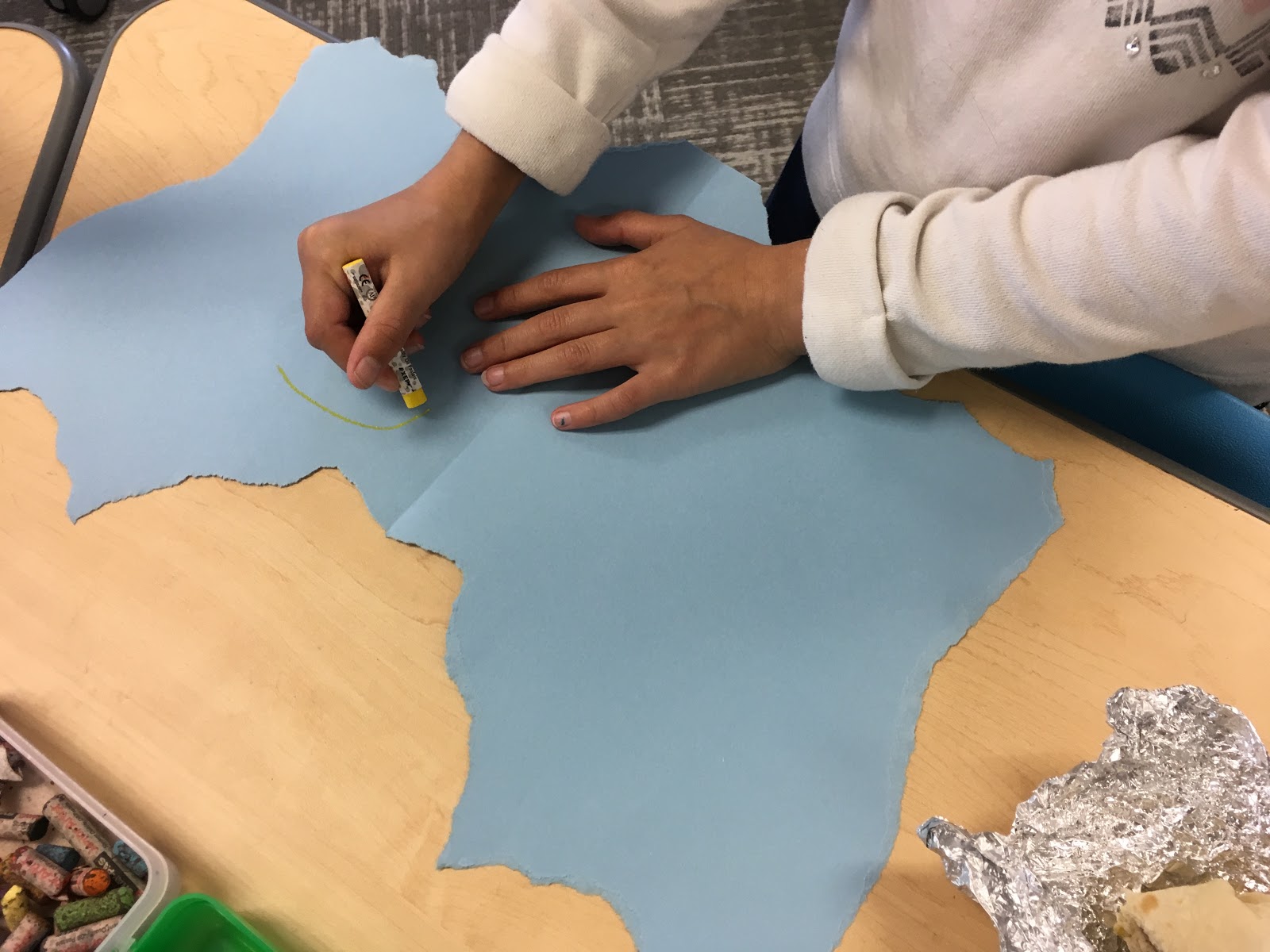
After our movement practice, it was time to begin creating artwork! I showed the students Basquiat's work again for inspiration. We talked about the idea of symmetry in art, and I explained that they would be creating a symmetrical shape that would become the head of a GIANT monster that we'd complete over the next few classes. And instead of cutting our shape we'd be RIPPING and tearing the paper to get the symmetrical shape we wanted. After demonstrating how to tear the paper with a little more control, they got started on their own creation. We used oil pastels to draw the details of the eyes, nose, mouth, and any other features they wanted to add! Here are the creations in progress!


Wednesday, September 5, 2018

Movement and Art: Becoming Lines

A Kindergarten artist transformed his squiggle into a dragon!
It is exciting to start another year of teaching with Mind Move Make!  I feel tremendous gratitude that I am able to bring mindfulness, movement, and art to children and adults in the Portland area.  I am thankful to spend my time working on and thinking about how to incorporate these three beautiful elements into a program that benefits others by offering skills and techniques in mindfulness and developing social-emotional learning.  So many of my passions get to interact and play together, all in the hopes of helping individuals find calm, develop self-regulation, cultivate creativity, explore emotions, and encourage a sense of community.  I am fortunate to engage in this work everyday.

During my first class of the school year at Alameda, we started by getting used to the space and getting to know one another.  All students sat in a circle eating their snacks as we went around the room sharing our favorite foods and our names.  This sharing activity allows the students to start to cultivate a sense of community.  After that, I asked them to define the three components of our class: mindfulness, movement, and art.  I also elaborated about each idea, adding on to what was already shared.  In terms of mindfulness, I explained that it was paying attention to what is happening RIGHT NOW!

Then, I asked the returning students if any of them would like to demonstrate what a "mindful body" looks like and talk about what a mindful body is.  One student raised her hand and showed us what her body looks like in the "mindful" position.  Everyone got the chance to try on their own versions of a mindful body, with an upright spine, criss-crossed legs, and hands either resting on knees or on the belly.  After taking a few big, beautiful breaths in this position I asked everyone to try to take a nourishing breath sitting in their most slumped posture.  Everyone agreed that this did not feel good in their bodies and recognized that it was very hard to take a deep breath.

 With everyone inhabiting their mindful bodies, we started our first Mindful Minute practice together.  This is something we will practice every time we come together as a group.  I invited everyone to either close their eyes or gaze down towards the floor.  At first, I asked the students to pay attention to the sound of the singing bowl; to listen to that sound until they could not hear it anymore.  When they could no longer hear the singing bowl sound, they were to put one thumb up.  Then they were supposed to listen closely to other sounds happening all around them.  I explained that at the end of this practice everyone would have a chance to share what they heard.

After that we got the wiggles out with a little movement.  I taught the students Tadasana, or Mountain Pose.  Asking them to become their strongest mountain, I went around and tried to gently knock each student over.  With their feet firmly planted, they created a very sturdy base that is difficult to topple.  Next, the students were invited to dance, move, and shake anywhere in any way that felt good in their own bodies.  And when I rang the singing bowl, they were to once again find their Mountain Pose and follow their breath.  Everyone did a great job, and no mountains were crumbled as everyone remained strong and steady!

This is the second year that Mind Move Make has offered classes at Alameda Elementary.  This year, the students in the class are mostly Kindergarteners with a few returning first graders also participating.  For our first class I wanted to see where they were skill-wise in terms of art.  This would tell me where I could go with them this session in creating art.  To do this I brought back a project I did with first graders for many years while I was an art educator.

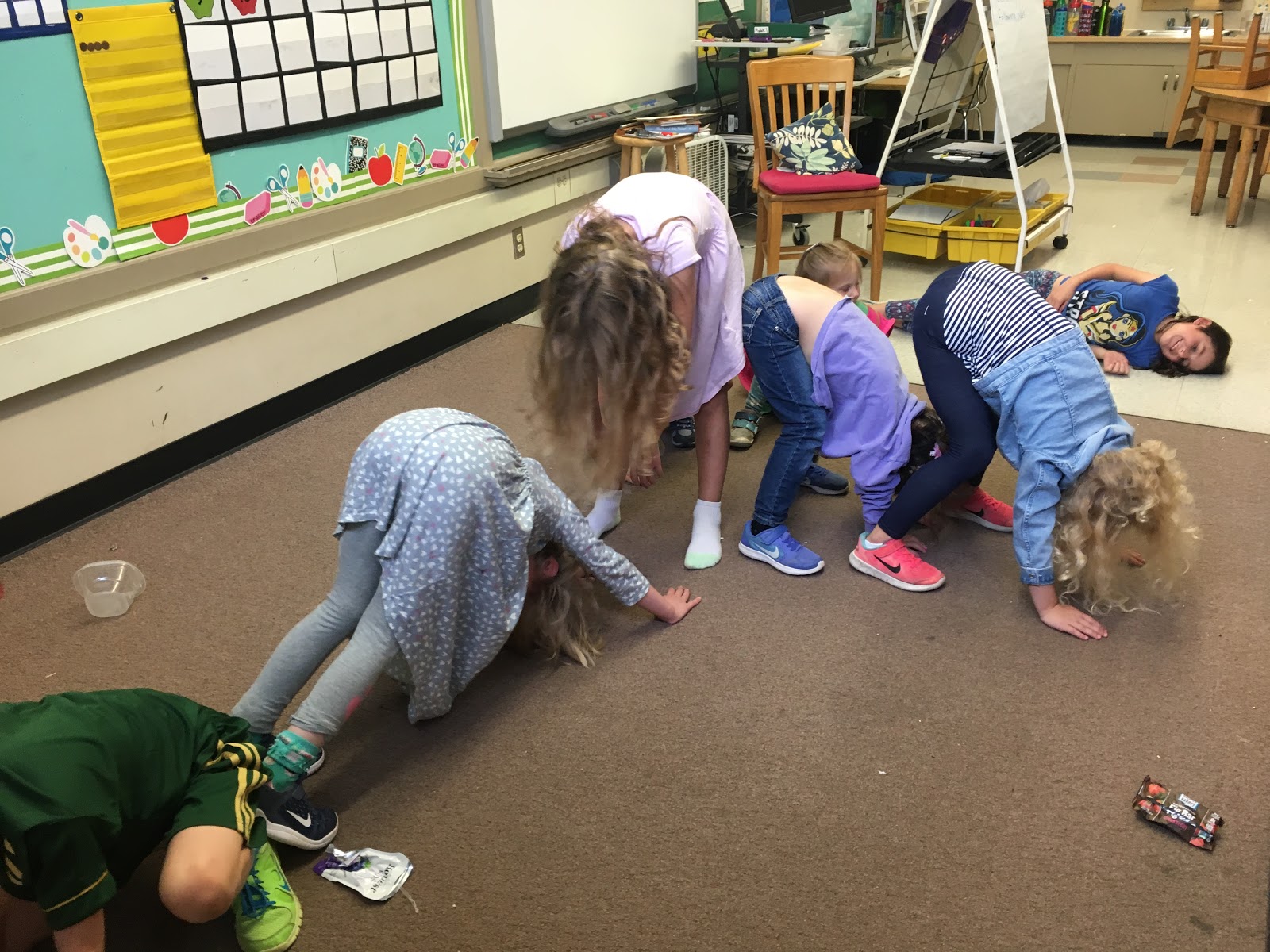
First, we read the book The Squiggle by Carole Lexa Schaefer.  In the book, a class of young children are walking with their teacher through a park in a straight line.  One imaginative little girl picks up a red string and proceeds to imagine that it is everything from a dragon, to the moon, to the Great Wall of China.  In terms of art elements, it is a great way to introduce the concept of line.  After reading the book and talking about it, we became many types of lines with our bodies.  Some children worked with partners to become lines, and some chose to work alone.  Together we became wavy, diagonal, horizontal, vertical, scalloped, and many more.  

These students are working together to create a zig-zag line!
Here are some of the different lines we transformed our bodies into!

After engaging in the movement work of becoming lines, I explained the art portion of our class.  For each student I created a "squiggle" line.  As artists, their job was to transform this squiggle into something from their imagination, just as the little girl from the book used her imagination to transform the red string.  Well, I was blown away by the imaginations of the students, their art skills, and the difference between everyone's drawings!  If this first class is any indication, we will be able to do a lot of fantastic artwork this session in Mind Move Make!  Here are some examples of the different drawings: