Tuesday, May 15, 2018

Happiness


HAPPINESS: What makes you feel happy, joyful, playful?  These were the questions Mind Move Make students focused on during two classes for Session 3.  Happiness was the first idea we worked with; there will be four ideas in total.  We are collecting four objects in a bag created by the students, and each object will represent the idea that we are currently looking at.  It is important to recognize the things we do in life that bring happiness so that we can observe and celebrate these experiences.  From a neuroscience perspective, our brains are hard-wired to notice the negative things that happen.  Focusing on happiness can work to change the neural pathways of our brains so that we see clearly the joy that exists in life.

Sitting in a circle during the beginning of our class together, I asked the students to close their eyes and find their mindful bodies.  When everyone was ready,  I placed a special object into each child's open palm.  The object was a smooth, clear glass stone.  Before opening their eyes I asked them to explore the object using only their sense of touch, then they could open their eyes and really look at it.  We had a discussion about happiness and I asked them to call to mind what brought them happiness.  After talking about and sharing a few things that bring joy to the students, I asked them to close their eyes and put all their happiest thoughts, ideas, and memories into the stone.  We focused on our breathing as we explored happiness in our own minds.

During the movement part of our class, the students spent time bouncing and shaking in all sorts of ways focusing on bringing energy into the body.  After some boisterous movement paired with cat/cow and down dog I asked the students to come into their favorite yoga pose and focus on why they like this pose.

Art-wise, I explained to the students that they would develop a symbol for themselves that represented happiness.  This class was devoted to brainstorming images that could become this symbol.  I asked them to think about the actions, people, and places that bring them joy and perhaps transform one of these into their symbol.  As usual, the students surprised me with their creativity.

A second grader's bag with her happiness stone sitting inside.


This fourth grader's ideas of happiness involve music, nature, and sunshine.


This Kindergartner is happy in nature.


Monday, May 14, 2018

A Handful of Quiet

Welcome to Mind Move Make, Session 3!  My inspiration for this session came from the book A Handful of Quiet: Happiness in Four Pebbles by Thich Nhat Hanh.  The book is based on a retreat that Thich Nhat Hanh lead for children; during the retreat he had the children find four pebbles, and each pebble represented a different idea.  The pebbles were placed in a tiny pouch that the children sewed themselves; the pebbles served as reminders of the ideas they talked about during the retreat and of their time together.


During our first class of Session 3 I explained to the students that throughout the course of our time together I would be giving them four treasures.  Each treasure would mean something different.  Today they would be creating the bag in which to keep their treasures.

Before we started crafting the fabric container for our special objects, we played a game to get to know everyone's names and to move our bodies in new and different ways!  I asked the students to figure out how many syllables are in their own name.  We went around the circle and clapped out the syllables for each child's name.  Then everyone stood up in a circle and each student developed a movement for the syllables in his or her name.  I started us off by creating a movement for each syllable in JULIE, and then the students took over!  It was fun to see movements matching the personalities of the students who developed them.

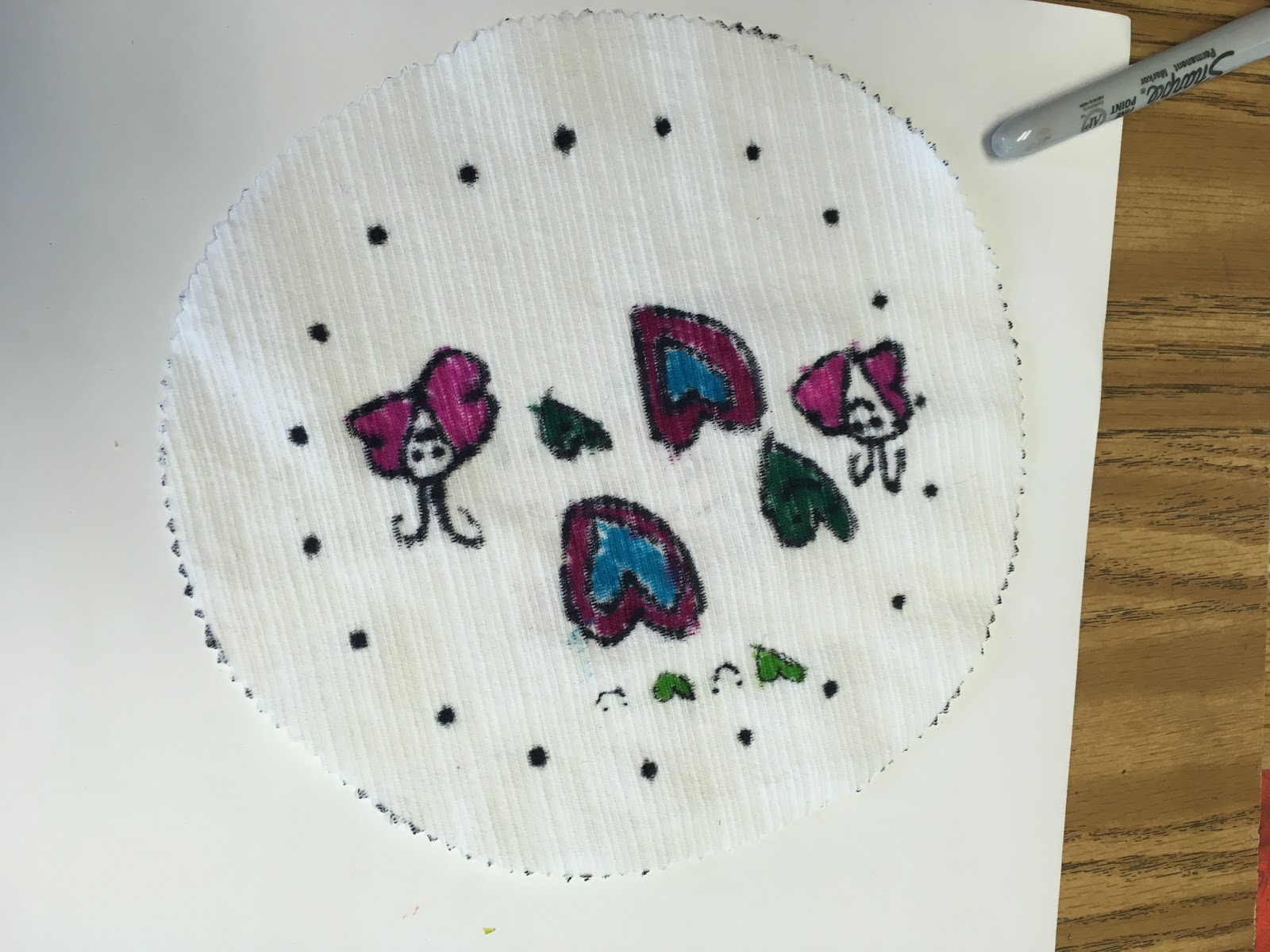
I knew the fabric bag would take the majority of the class to create, so I demonstrated the sewing and told the students they were to create the most beautiful container they could to house the four special objects that I would give them.  There were so many variations in the designs they drew onto the 8" circular piece of fabric.  When it came to the sewing part of the project I encouraged the older students to help the Kindergarteners and the children who had never sewn before.  So many of the kids were willing and excited to help the others who needed it.  Many of the students have been in my class for multiple sessions, and we have built a strong community.  I saw that community in action during this project.

Here are some pictures of students at work along with some of the finished bags!


Wednesday, March 21, 2018

Over the Ocean


Second grade artist
 During two Mind Move Make classes we became intimate with Taro Gomi's lovely book Over the Ocean.  Japanese author and illustrator Taro Gomi is best known for her hilarious book Everybody Poops.  All of her books share charm and whimsey.  Over the Ocean tells the story of a little girl standing on a beach and wondering what exists on the other side of the ocean.  She is young enough to invent all sorts of interesting, imaginary scenarios about what might be across a vast expanse of water.

In starting the class I asked the students if they had ever visited the ocean.  Everyone raised their hands.  I asked if they ever imagined what was on the other side?  We shared a few ideas before I began reading the book.

One thing I adore about teaching children is that they always notice things that I might not.  After reading the book, a couple of my students recognized that the same boat is in every single picture frame throughout the book.  Together we looked through the book a second time and observed that one small boat travels from one side of the book to the other throughout the course of the story.  The only page it does not exist is the last one, and we are left to believe that it still travels on beyond the scope of our vision.  What a beautiful detail and how wonderful that my students saw it.  This reminds me that there are many ways of paying attention in the world.

After exploring this discovery, the children went on an imaginary trip to the ocean.  They had the opportunity to become comfortable, close their eyes, and tap into their senses to recreate the ocean in their minds' eye.  We went through all of the senses and they imagined what they would hear, see, smell, taste, and feel in a place where water meets sky.  Then I asked them to visualize what could be on the other side of the water.  All students had the opportunity to share what they saw as we went around the circle and shared our experiences.  Standing in a circle, each student became something her or she saw, heard, felt, or tasted during the imaginary experience.  The room filled with seagulls, seashells, ocean waves, and sunshine as the children transformed themselves.

Then the students got to travel to the ocean through movement.  They started by becoming the ocean waves in a seated position, rolling forwards and backwards through the spine.  In child's pose we became seashells, arms and legs waving we became jellyfish.  Through yoga poses and movement we transformed ourselves into seaweed, mermaids, starfish, and dolphins.  Then we found ourselves on a sandy beach, lying in Savasana and enjoying the warm sunshine on our skin.  What an adventure!

Over the course of two classes the students created a collage inspired by the book Over the Ocean and by our imaginary travels.  I provided beautiful, decorative paper in many shades of blue and green that these artists turned into waves of the ocean.  The students also had the opportunity to cut out the drawings of what they contemplated existed on the other side of the water and add them into the picture.  Here are some of the works in progress along with some of the completed creations.  


Kindergarten grade artist (work in progress)

Kindergarten artist

Kindergarten artist

Second grade artist

Fourth grade artist

Kindergarten artist

Third grade artist
Kindergarten artist

Tuesday, March 20, 2018

Sending Ourselves Kind Wishes


Kindergarten Artist
During our last few Mind Move Make classes we focused on sending kind wishes to people we love.  Today we will concentrate on sending kind wishes to ourselves.  We will only spend one class on this, but it is such an important practice!  Mindfulness teaches us to hold ourselves gently and non-judgmentally and offers us a healthy dose of self-compassion.  Practicing sending ourselves positive thoughts can feel strange at first, at least it did to me.  But it is imperative that we give ourselves the same kind of care and love that we offer to others around us.  Children can start negative self-talk at a very young age, and this practice is the opposite of that.  So many wonderful things are taught at school, but unfortunately self-care and self-compassion are usually not part of the curriculum, and these are some of the most important tools that we need to be happy throughout life.

I asked the students two questions and we discussed them:

Why is it important to be kind to yourself?
                                                            What do you do to take good care of yourself?

I had the students turn to a friend sitting next to them and talk about these questions, then we shared together as a group.  We talked about how mindfulness can help us take care of ourselves because it allows us time to listen to our emotions.  It allows a pause, a rest, a time to connect with what is happening without worrying about past or future.

After that I invited the students to find their mindful bodies and close their eyes if they felt comfortable doing that.  I asked them to imagine themselves doing something they love to do, something that makes them happy.  "Imagine yourself with a big smile on your face and pay attention to how you are feeling," I said.  After letting them settle into that picture in their minds, we sent ourselves these wishes:

May I be healthy
May I be happy
May I be peaceful

Afterwards, we discussed how it felt to send kind thoughts to ourselves.  All the students seemed to feel pretty good about it!

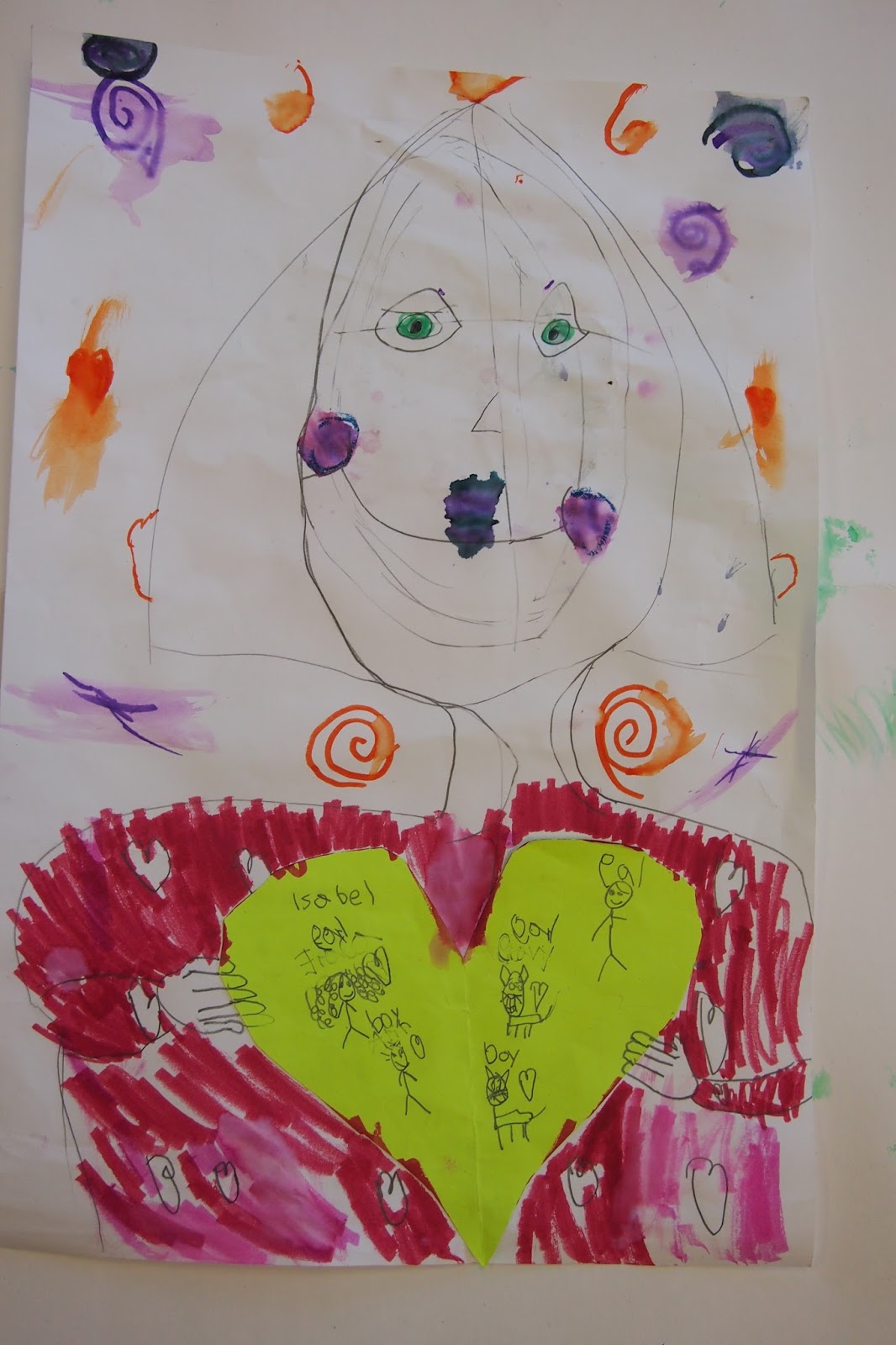
During the art part of our class we began creating self-portraits.  I demonstrated some very basic things about the proportions of the human face and they got started creating themselves!  We are incorporating the hearts we designed with all the people we love inside them into the self-portrait drawing.  Here are both works in progress and a few of the finished artworks!

Second Grade Artist

Kindergarten Artist

Kindergarten Artist

Kindergarten Artist

Second Grade Artist

Fourth Grade Artist


Kindergarten Artist


First Grade Artist

Tuesday, February 13, 2018

In My Heart

Valentine's Day is this week, so Mind Move Make students are focusing on sending kind wishes to the people they love, the practice of loving kindness!  Loving kindness develops compassion for other people and strengthens emotional intelligence.  Research shows that practicing loving kindness creates beneficial changes in the brain by increasing positive emotions and decreasing negative emotions.  It also leads to a sense of gratitude for all the people we have in our lives.

After playing a movement game that involves learning every one's names, we read a book called In My Heart by author and illustrator Molly Bang.  In My Heart is about a mother who is explaining to her son that even when they are apart he lives inside her heart all the time.  No matter what she is doing, he is there with her in some capacity.  The mother tells her little boy that he carries all the people he loves the most within his heart also. 

This is my favorite image from the book.  It is an illustration of the little boy sleeping, and all the people he loves are still with him:


After discussing the book I asked the children to picture all the people they love resting inside their own hearts.  Then I asked them to select one person who they see everyday, a person who makes them very happy, and visualize this person.  "Imagine that this person is happy and peaceful, doing something he or she loves to do." I said.  I explained that we would be sending their loved one kind thoughts.  "Repeat these ideas in your head after I say them out loud," I said.  I paused after each phrase, allowing the message to sink in and giving time for reflection.  These were the kind wishes we sent:

May you be safe
May you be healthy and strong
May you be happy
May you be peaceful

I gave the students time to send kind wishes in their own words by giving them space and silence.  Looking around the room, all the children were focused and immersed in thoughts of their loved ones.  After practicing together I gave the children the opportunity to share who they were thinking about and how the practice made them feel.  I explained that this was optional and that they were welcome to say "pass" if they did not want to share.  Everyone agreed that practicing loving kindness made them feel good, and most students chose to share who they were thinking about.

For the art portion of the class, the students cut out a heart shape and drew all the people they love most in their own hearts.  They could either use pencil or permanent marker.  Here are some images of the students' drawings.


Friday, February 2, 2018

Mind Move Make Art Show

Mind Move Make students had the opportunity to participate in an art show at Miss Zumstein's Bakery in Northeast Portland!  Julie Jansen, teacher and founder of Mind Move Make, collaborated with her four-year-old son to create a series of artwork.  This work was featured at Miss Zumstein's Bakery during the month of February, 2018.  She chose to also include artwork from her Mind Move Make students.  The Mind Move Make work exhibited was in connection with the Imagination unit.
Along with the regular Mind Move Make students, Julie also worked with children from her son's preschool.  All of the children were asked three questions:

What is the imagination?
Are all imaginations the same or are they different?
Where does your imagination live within your body?

Here are some pictures from the art show, both of the children's work and the collaborative work Julie made with Harlow.

Artwork by Alameda and The International School Students

Artwork by Alameda and The International School Students

Artwork from The Peanut Gallery Preschool


28 Studies by Julie and Harlow


Installation by Julie and Harlow

Installation by Julie and Harlow

Installation View
Here is Julie's artist statement from the show:

Harlow and I began creating this artwork together one year ago.  He was on the verge of turning three and I wanted to once again engage in the creative process on a deeper level.  After having two children it became difficult to find the time or the energy to make work.  My process needed to connect with other parts of my life so that one thing could more easily flow into another.  Exploring how everyday life intersects with art and practice I worked with the elements that exist around me: my son’s hands and immeasurable energy, his drawings, paintings, and developing language, and fascinating objects we discovered along our path.  This work attempts to blur the lines between different aspects of my life and bring a sense of wholeness.  

Most of the objects in the show were gathered on walks through our neighborhood, visits to the park, and explorations in the backyard.  To a three-year-old child, the experience of holding a stick or rock, feeling its form, and bringing it home becomes an important, urgent matter.  Place, time, and movement are all contained within each item presented.  This collection becomes a curation of our movement through time and physical space, an unusual documentation of moments whose beauty overflow the boundaries of otherwise mundane objects.  

Collaborating with Harlow became an exercise in letting go.  In trading the artwork back and forth I would watch as my favorite parts of a drawing or painting disappeared as he altered the piece into a new incarnation.  Our collaboration also brought a playful attention to the present moment as we observed colorful drips slowly travel down the paper, experimented in painting with sticks, and mixed new colors in a Harlow-esque palate.  


Both questions and ideas presented themselves through the process of creating this work.  Some sources of inspiration include childbirth, phytoplankton, charnel grounds, ferns, blandness, looking at plants on a cellular level, and contemplating what would happen if humans and plants could become hybrid creatures.  Walking through our neighborhood, gentrification and change cannot be ignored.  Much of the wood gathered here is from a house that we watched as it was slowly demolished, then we witnessed as two new homes were built as replacements observing acts of displacement and upheaval.  Through this work I question our current curatorial practice.  What is and isn’t art, what is good, and who decides?  How is beauty contained within an object?