Thursday, January 26, 2017

Water Collaboration

During Mind Move Make classes, we always start with two minutes of mindful breathing.  This gives the children a chance to relax, reset, rest their minds, and reconnect to themselves after a busy day at school.  In connection with our Central Idea, we are connected to the ocean in many ways, today I asked the students to bring their minds to the places in their bodies that are made of water   Before starting I asked them if they could think of any parts of their body that contained water.  We decided our eyes, inside our mouths, and our blood were all places that water exists in the human body.  During our mindful breathing time, I reminded them to think of these places and what they do for us.

We had a fun time during the movement part of our class today; we played Water Charades!  Students broke into groups of three, and I gave each group a type of water to act out together.  It was interesting watching them collaborate to figure out the best way to show a river, a waterfall, a lake, raindrops.  Each group performed their tiny movement pieces describing water, and the other group guessed what they became.  Actually, the students didn't want to stop playing the game because they were having such a great time!  

Three boys working together to create "raindrops" as a movement piece!
After that, it was time to start the art part of the class.  The students worked on Mini-Masterpieces!  They each created several tiny artworks describing different types of water.  This project gave them the chance to explore many ideas relating to water using several types of art media.  They used collage, oil pastels, watercolor paint, pencil, and markers to complete these works of art.  Here are a few of the artists in action, along with some finished pieces!


Thursday, January 12, 2017

Under the Ocean

Today we started a new session for Mind Move Make: Under the Ocean!  During this session we will explore our Central Idea: We are connected to the ocean in many ways.  Through mindfulness, movement, and art we will investigate how humans are connected to these vast expanses of water that exist on planet Earth.

Before diving into studying the ocean, I wanted us to contemplate the concept of water itself.  I asked the students to think of as many forms of water as they could come up with.  How would you describe water?  What are some of the ways we experience, see, and feel water?  Together we came up with many interesting responses: rain, tears, blood, lakes, rivers, waterfalls, steam, ice, and many others!

Then we began talking about the percentage of water that exists within our own bodies.  In children, the percentage is around 65%.  Our bodies are more connected to water than we realize.

After talking about this, I asked all students to physically become water through movement.  They could move anywhere they wanted to throughout the classroom, becoming any kind of water they wanted to become!  Instantly, students began collaborating to become waterfalls, rivers, and rain.  A few students seemed a little overwhelmed by the thought of becoming any kind of water at all, so after a few minutes I guided them to become more specific types of water.

After channeling water through movement, we were ready to depict water through artwork!  I supplied the students with watered-down tempera paint in cool colors: blues, purples, and greens, plus white for tinting.  I also gave them tools to create texture within their paintings.  They jumped into creating watery worlds with paint!  Here are a few pictures of the students in action.


Thursday, November 3, 2016

Emotion Explorations: Brave


What does it mean to be brave?  This is the question I posed to my students during this Mind Move Make class.  I was impressed that every student who responded to this question paired bravery and fear together.  One third grader said, "Being brave is when you are scared to do something but you do it anyway".  I couldn't have said it better myself!

I thought that perhaps children growing up in our society, with muscular superheroes serving as roll models, would equate being brave with physical strength or fearlessness.  But they all realized that being scared and being brave go together; you can't have one without the other!  As Nelson Mandela said, "I learned that courage was not the absence of fear, but the triumph over it."

I asked the children in my class if they could remember a time when they felt brave.  One kindergarten student recounted a memory when her mother hurt herself pretty badly and she had to walk with her to get help.  She said she was scared, but she did it anyway.  What a great example of being brave!

After our talk, I read the book Life Doesn't Frighten Me.  The book includes a poem by Maya Angelou and paintings by artist Jean-Michel Basquiat.  It is about a little girl who remains brave in the face of the many frightening things happening in the world around her.

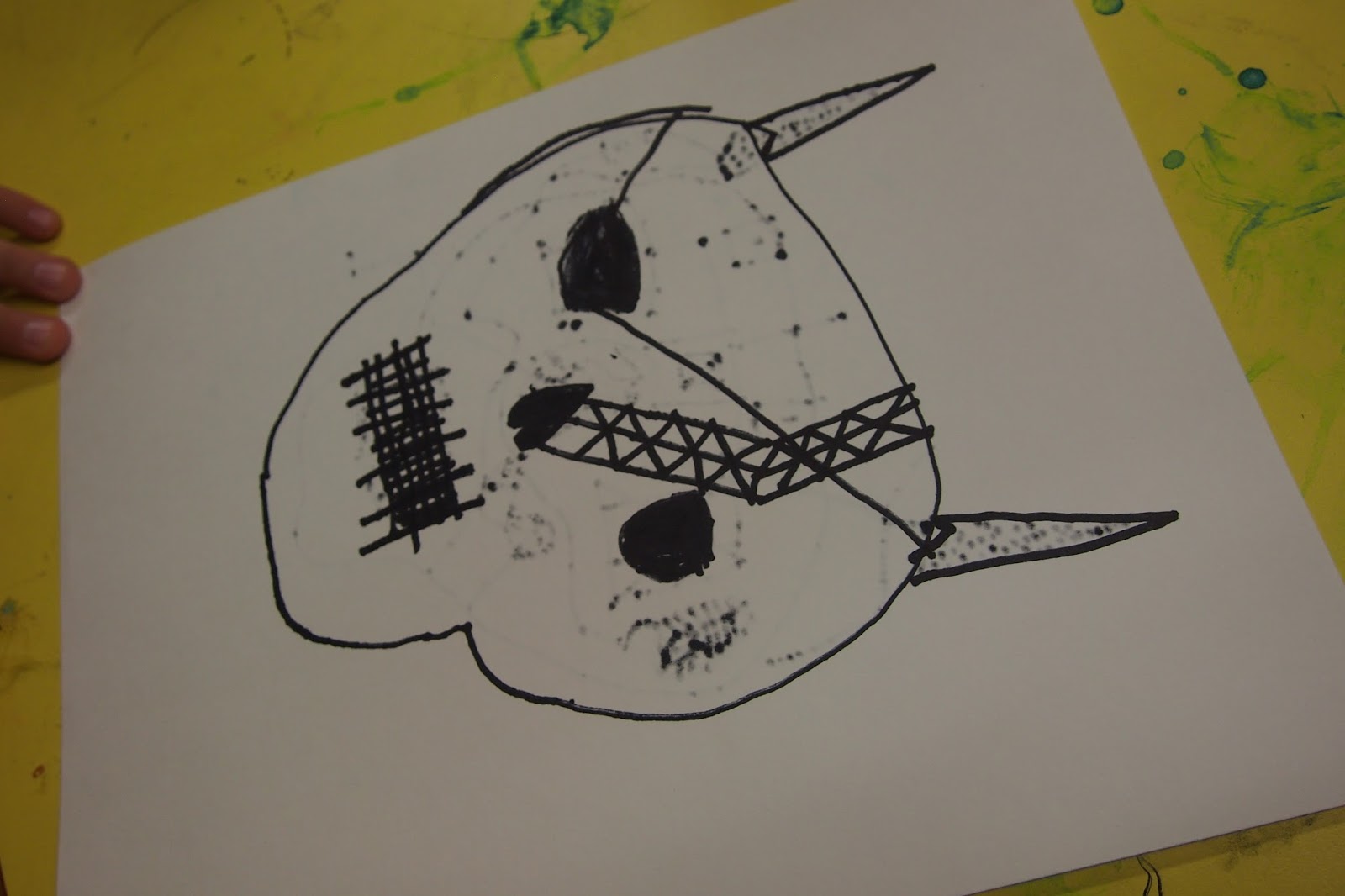
   After engaging in many brave Warrior poses during the movement portion of our class, the students designed "brave" monsters in their sketchbooks.  Many of these monsters were two-headed creatures.  One part of them represented the "fear" side of bravery, and the other the "brave" side.  Here are the artists at work!


Monday, October 31, 2016

Discussing Anger and Fear

We've done a lot in the past few Mind Move Make classes!  Through movement, art, and children's literature we've continued to explore the emotion "anger".  We read When Sophie Gets Angry-Really Really Angry... by Molly Bang.  In the book, a little girl becomes extremely angry when her sister takes her favorite toy.  Then she takes a walk in nature and she is calmed by the act of climbing a tree and listening to the wind and the ocean waves.  We talked in small groups about what we do to calm ourselves down when we feel angry.  It was interesting to hear everyone discussing these ideas with their peers.

We've also tried the "Take Five" breathing exercise.  For this, the students spread their hands in front of them like a starfish.  Then they trace each finger, starting with the thumb.  Sliding their finger up the thumb, the students inhale through the nose.  They pause at the top of the thumb, then exhale through the mouth as they slide their finger down the thumb.  For each finger, the students inhale while tracing up, and exhale while tracing down the finger.  This gives them the chance to focus on taking five good breaths, with the physical object of their own hand to concentrate on while breathing.

During another Mind Move Make class, in celebration of Halloween we looked at the emotion "scared".  I read one of my favorite Dr. Seuss stories, What Was I Scared Of?, then we talked about different things that we are scared of in our own lives.  The students had just experienced an earthquake drill that day and many of them said they were scared by the loud alarm that went off for the drill.  After talking about our fears, each child designed a "scared" monster in his or her sketchbook.

Our last class was a "catch-up" day.  Many students hadn't finished their angry "Bombaloo" masks, so I gave everyone the opportunity to complete the mask.  Also, several students had unfinished monster designs in their sketchbooks, so they had time to go back and work on those.  At the end of the class we took a group photograph of all the children wearing the "angry" masks that they designed.  What a fun bunch of kids!  


Thursday, October 6, 2016

Sometimes I'm Bombaloo!

At the beginning of every Mind Move Make class we start with a minute of mindful breathing.  During our very first class, the students learned what a mindful body looks like, feels like, and sounds like.  We practice finding our mindful bodies, focusing on our breath, and listening to the sounds around us.  Afterwards we talk about if mindful breathing was easy or hard that day.  The students' responses to this question change during every class, just as the experience of mindfulness changes each time you practice!

After our mindful breathing work, I explained that we'd look at the emotion "anger" again this week.  I read them the book Sometimes I'm Bombaloo by Rachel Vail.

Sometimes I'm Bombaloo is about a girl named Katie who describes herself as a "really good kid".  She picks up her toys, brushes her teeth, and "gives excellent hugs".  But when her baby brother destroys a castle she worked hard to create, she becomes uncontrollably angry and turns into "Bombaloo".  She pushes her little brother, smashes things, and throws all the clothes out of her drawer.  After she calms down and becomes herself again, she says, "It's scary being Bombaloo".  I think we can all relate to that!  Being angry can feel very scary.

I asked my students if they had ever become "Bombaloo"; if they had ever done something they regretted after becoming very angry.  I told them about a time that I yelled at Harlow, my two-year-old son, when I became angry.  Afterwards I felt awful.  Becoming angry is part of being human, but it can be frightening.  Mindfulness helps us by giving us space between the thing that is making us angry and our reaction to that thing.  Even taking one breath before reacting when we're angry helps us to calm down and gives us space to make a good choice.

I explained that we were going to create masks depicting our inner "Bombaloo".  "What does your Bombaloo look like?" I asked them.  I also asked them to think about the colors they would use to show their angry side, along with the facial expressions.  During our movement time, they had the chance to become "Bombaloo" on their yoga mats.  They made Bombaloo-esque noises, Bombaloo faces, and moved like their version of Bombaloo.  It was fun watching them channel this part of themselves!

During the art portion of the class, the students started designing their masks!  All of them are extremely different, just as our experience of anger is different from anyone else's.  We used pencils to start the design, then we used oil pastels to add color.  I explained that next week I'd bring watercolor paint so that they could add a paint layer.

Here are the artists at work, along with some of the works in progress!


Thursday, September 29, 2016

Emotion Explorations: Anger

Anger can be a challenging emotion to experience, and this is what we explored during our third Mind Move Make class.  I asked if anyone in the class had ever felt angry before, and every raised a hand (including me!).  In fact, most of the students had experienced anger that very day.  All of the students took turns sharing a time that they felt angry, and it was interesting hearing the things that made them feel this powerful emotion.  One girl talked about a friend who had broken a promise.  Another student shared a time that a cousin was unfair and cheated while they were playing a game.  

I asked the students to think about where they feel "anger" in their bodies.  For example, I told them that when I get angry I feel my cheeks getting hot first, then it spreads to my forehead and my entire face!  One student said she feels anger in her back when it gets tight.  Someone else felt anger in her chest, and her heart pounded really fast.  Noticing how the body feels when experiencing an emotion lets us know that the emotion is coming.  It is like the doorbell ringing before an important visitor comes to our house.  The feeling in the body is the doorbell and the emotion is the important visitor; our body lets us know which emotion we are having.

We talked about how feeling anger is part of being human.  Mindfulness allows us space between anger and our reaction to anger.  This space gives us more control; it gives us a choice for how we respond to anger, along with all the other emotions. 

After that, I let the students explore "anger" by making an angry face at one another, and making angry noises!  It is important to know what "angry" looks like, though almost everyone ended up laughing at one another's funny, angry faces!

Three students finding Child's Pose

During the movement part of our class, I taught several familiar poses along with a couple of new ones: Dolphin Pose and Sphinx Pose.  Giving the students the space of their yoga mat, I asked them to explore "anger" through movement!  They could stomp, make noises, or find a pose that felt particularly "angry".  It was fun to watch the results.

In their sketchbooks, each student designed an "angry" monster.  Through color, facial expression, shape, and scale they developed their creatures.  Here are a few from this class:


Friday, September 23, 2016

Emotion Explorations: Excited

First Grade Artist
What does "excited" mean to you?  This is the first emotion we investigated during Mind Move Make class in the Monsters and Emotions unit!  First, I had the students guess what emotion we would explore by reading the "excited" part in On Monday When It Rained, an excellent book by Cherryl Kachenmeister that identifies different emotions from a child's point of view.  No one guessed the emotion "excited" but every student enthusiastically voiced ideas about what the emotion might be!  Then, I asked each student to make an "excited" face for one another, which was fun to watch.  After that I read the "excited" part of the book The Way I Feel  by Janan Cain and asked them to think about a time when they felt excited themselves.    

After that it was time to move!  The students selected their yoga mats and we were ready to go.  We practiced Child's Pose, Downward Facing Dog, and Downward Facing Frog together.  Then we tried to feel every vertebra in the spine as we went from a forward fold to a standing position in "rag doll" style.  The students matched breath and movement while cycling through several Sun Salutations.  Then I asked them to invent a yoga pose that felt "excited" while staying in the defined space of their own yoga mats.  I loved watching the joyful movements they came up with while exploring "excited" with the whole body.

This session is titled Monsters and Emotions because the students are working on designing a monster for each emotion we investigate.  Last week I gave each child a sketch book, and by the end of Session One, everyone will have a collection of monsters to represent several human feelings.  Sometimes we will go beyond the sketch book and create more involved artworks.  These creative investigations of emotion will give the students the opportunity to visually describe what each feeling means to them.

To get the students in a monster kind of mood, we read Romping Monsters, Stomping Monsters, an energetic, fun-loving book by Jane Yolen. From the book and from many other visual resources the students received inspiration for designing their own "excited" monster. Before they started, we discussed the colors and facial expressions an "excited" monster might have. Everyone had a different idea about this, as everyone experiences emotion differently. It was wonderful to watch the artists at work!